Who Should Control AI? Lessons from the Dao De Jing on Tech Nationalism
What happens when strategic technology becomes something everyone hoards—and why true AI sovereignty requires open building.
I have been thinking about AI quite a bit lately.
Not just about which model is better or which company has more GPUs.
More about where all of this is heading.
There is a lot of talk nowadays about AI being a strategic technology. The US wants to stay ahead of China. China wants to become less dependent on the US. Countries are talking about AI sovereignty, semiconductor supply chains, GPUs, data centres and who controls the technology.
I understand why.
If AI is going to become an important part of the economy, then naturally countries want to have some control over it.
But I think there is another question that we don't talk about enough.
What happens when the technology that could benefit everyone becomes something that everyone is trying to keep away from everyone else?
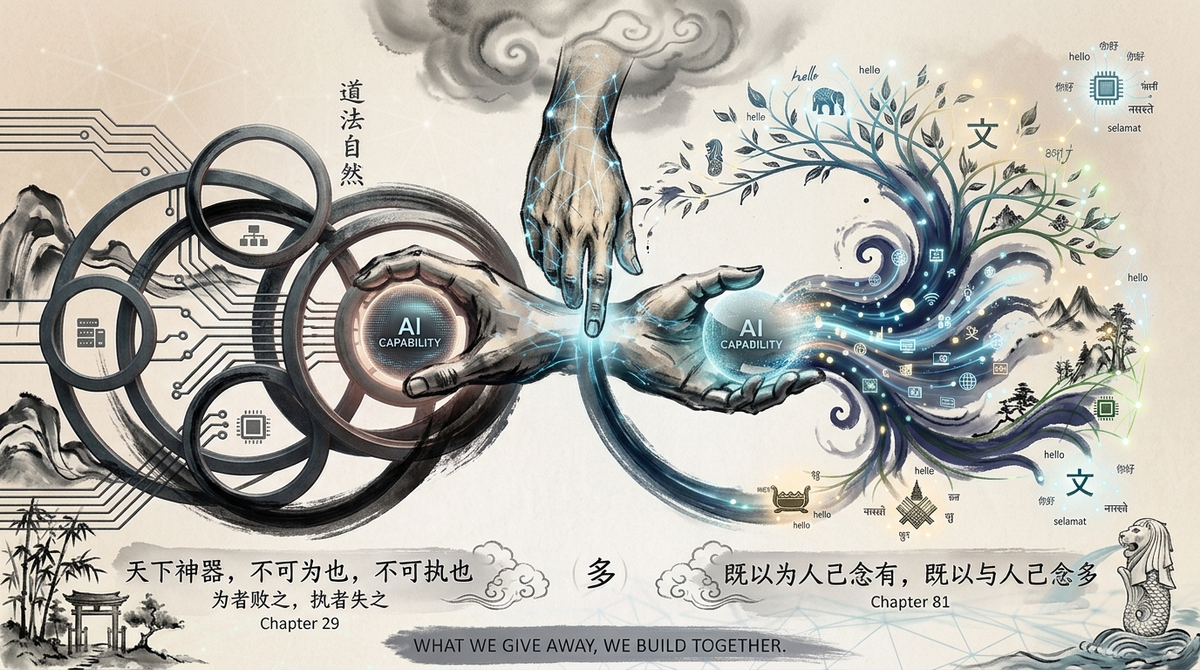
And this is where I have been thinking about something from the 道德经.
The more you give, the more you have
There is a line in the 道德经 that I have always liked:
既以为人己愈有,既以与人己愈多。
The more you do for others, the more you have.
The more you give to others, the more you possess.
It is from the final chapter of the 道德经, Chapter 81.
I find this idea quite interesting.
Because on the surface, it doesn't make much sense.
If I have something and I give it to you, shouldn't I have less?
If I have ten dollars and give you five dollars, I now have five dollars.
Simple.
But knowledge doesn't really work that way.
If I teach you something, I don't suddenly know less.
If I publish a piece of software and you use it, I haven't lost the software.
If you take what I built and improve it, I might actually end up with something better than what I started with.
This is one of the strange things about technology.
Sometimes giving something away makes it more valuable.
And I think this matters quite a lot for AI.
AI is not just another product
I don't think AI is going to remain just another piece of software.
It is already becoming part of how we work.
We use it to write.
We use it to code.
We use it to research.
We use it to learn.
Companies are using it to automate things that previously required people.
And this is still very early.
So if AI becomes part of the infrastructure of society, I don't think it is healthy for the capability to be concentrated in just a handful of companies and countries.
This is also why I don't quite agree with the idea that the best AI has to come from one particular part of the world.
Why?
Because English isn't the only language in the world.
And America isn't the only culture in the world.
This sounds obvious, but I don't think we always behave as though it is obvious.
The world is bigger than English
I live in Singapore.
If I ask an AI model about something in Singapore, I can usually get a reasonable answer.
But sometimes there is something slightly off.
It knows the words.
It understands the sentence.
But it doesn't quite understand the context.
And I don't think this is necessarily because the people who built the model are deliberately biased against Singapore.
That would be too simplistic.
It is probably because the data, people, priorities and resources that went into building these models are not evenly distributed around the world.
And there is now research that is beginning to demonstrate this problem more systematically. A 2026 study of culturally grounded reasoning in Southeast Asia found that frontier models still perform poorly on some regional tasks, with many failures linked to missing cultural knowledge. SEA-adapted models and culturally aware prompting improved some of those results.
That matters.
Southeast Asia has a huge number of people.
We have English, Mandarin, Malay, Indonesian, Thai, Vietnamese, Tamil, Burmese, Khmer, Filipino and many other languages.
And even when we speak English, we don't necessarily think about everything in exactly the same way.
There are cultural assumptions that don't translate neatly.
There are jokes that don't translate.
There are social norms that don't translate.
There are things that someone who grew up here would simply understand without needing an explanation.
That is why I think it is important for Southeast Asia to build AI for Southeast Asia.
And we are already seeing this happen.
SEA-LION, developed by AI Singapore, is now a family of open models specifically designed around Southeast Asian languages, cultures and local knowledge. Its latest generation includes models built for multilingual, reasoning and multimodal use cases, and the project has also developed safety-focused models around Southeast Asian cultural norms.
I think that's a good thing.
Actually, I think we need much more of it.
I want more frontier models, not fewer
I want American AI.
I want Chinese AI.
I want European AI.
I want Indian AI.
I want Southeast Asian AI.
I want Japanese AI.
I want Korean AI.
I want African AI.
I want all of it.
Not because I think every country needs to build its own ChatGPT.
That would be rather silly.
But because I don't think humanity should have only one centre of technological intelligence.
Different people will build different things.
They will have different priorities.
They will notice different problems.
They will make different mistakes.
And sometimes they will find solutions that another part of the world would never have thought about.
That is useful.
Competition is useful.
But there is a difference between competing and trying to prevent someone else from building.
This is where geopolitics gets interesting
The US and China are now competing heavily over AI.
And increasingly, the competition isn't just about models.
It is about GPUs.
It is about semiconductor manufacturing.
It is about access to advanced chips.
It is about data centres.
It is about who controls the supply chain.
It is about who can manufacture the hardware required to train the next generation of models.
This is not hypothetical anymore.
AI has become intertwined with national security and strategic competition.
I understand why this is happening.
If you are a government and you believe AI is going to be strategically important, you don't want to discover one day that your entire AI industry depends on another country that has decided it doesn't want to sell you the hardware anymore.
So you build your own.
China is doing exactly that.
The more restrictions are placed on access to advanced technology, the stronger the incentive becomes to develop domestic alternatives.
And perhaps that is inevitable.
But this is where I started thinking about another part of the 道德经.
When control goes too far
Chapter 29 says:
天下神器,不可为也,不可执也。
为者败之,执者失之。
The world is something that cannot simply be forced or grasped.
Those who try to force it fail.
Those who try to hold on to it lose it.
And later in the same chapter:
是以圣人去甚,去奢,去泰。
The sage avoids excess, extravagance and going to extremes.
I think there is something very interesting here when we look at the current AI competition.
I don't think Laozi was somehow predicting semiconductor export controls two thousand years ago.
That would be stretching it.
But the underlying idea is interesting.
There is a point where protection becomes restriction, restriction becomes control, and control starts creating the very outcome you were trying to prevent.
If you restrict China's access to advanced chips, then China has an even stronger reason to develop its own chips.
If you restrict access to foreign AI models, then there is a stronger reason to develop domestic models.
If you try to prevent another country from building its own technology ecosystem, you may give it a reason to become completely independent of yours.
You may slow them down.
But you may also make sure that they never want to depend on you again.
And eventually there are two technology ecosystems instead of one.
Maybe three.
Maybe five.
Perhaps that is just competition.
But perhaps it is also an example of what happens when control is pushed too far.
I don't think this means "open everything"
This is where I want to be careful.
I am not saying that countries should simply open everything and trust everyone.
That would be naive.
There are legitimate national-security concerns.
There are dangerous applications of AI.
There are reasons to control certain technologies.
There are commercial reasons for companies to keep some things proprietary.
I understand all of that.
The point is not that restrictions are always wrong.
The point is that restrictions can also have consequences.
And sometimes the response to a restriction is not compliance.
Sometimes it is independence.
Sometimes it is substitution.
Sometimes it is building a completely new ecosystem.
So maybe the question shouldn't simply be:
"How do we stop them from getting this technology?"
Maybe we should also ask:
"What happens after we stop them?"
That second question seems to be missing from a lot of the conversation.
I don't think America needs to lose
This is something I want to be clear about.
I'm not anti-American.
I don't want American technology to fail.
Quite the opposite.
America has produced an incredible amount of technology that the rest of the world benefits from.
And I don't think China becoming stronger in AI means America has to become weaker.
I actually think the world is better when both can build.
And when Europe can build.
And when India can build.
And when Southeast Asia can build.
The more capable societies we have, the more interesting the world becomes.
What I don't like is the idea that technological progress has to become a zero-sum game.
You have the technology.
Therefore I must stop you from having it.
You have the chips.
Therefore I must restrict them.
You have the models.
Therefore I must make sure nobody else can access them.
I understand why governments think this way.
But I don't think it is the only way.
Software taught us something
I've spent most of my career around software.
And software has taught me something rather important.
Sharing is incredibly powerful.
Open source is one of the biggest examples.
Someone writes some code.
They put it online.
Someone else uses it.
Someone else finds a bug.
Someone else fixes it.
Someone else takes it in a completely different direction.
And suddenly something that started as a small project becomes infrastructure used by thousands or millions of people.
The original developer didn't lose anything because someone else used the code.
In many cases, they gained something.
More contributors.
More users.
More ideas.
More improvements.
More people testing it.
The thing became more valuable precisely because it was shared.
I think AI can work the same way.
Not everything needs to be open.
But I do think we should ask ourselves whether the default instinct should always be to restrict.
Maybe sometimes the better question is:
What happens if we give this to more people and see what they do with it?
This is where I think Asia has an opportunity
Asia doesn't need to wait for America to decide what the future of AI looks like.
China certainly isn't waiting.
India isn't waiting.
Singapore isn't waiting.
And I don't think Southeast Asia should wait either.
We should develop our own capabilities.
Our own models.
Our own researchers.
Our own semiconductor expertise.
Our own infrastructure.
Our own talent.
Not because we want to isolate ourselves from the rest of the world.
Actually, quite the opposite.
We should build so that we can participate.
If we have nothing, then we have to accept whatever someone else gives us.
If we have capability, we can choose.
We can use an American model when it is better.
We can use a Chinese model when it is better.
We can build our own when neither is suitable.
We can combine them.
We can improve them.
We can contribute back.
That, to me, is what technological sovereignty should mean.
Not isolation.
Freedom to choose.
Give more
Maybe this is the part where my thinking becomes a little idealistic.
But I don't think that's necessarily a bad thing.
I keep coming back to that line from the 道德经.
既以为人己愈有,既以与人己愈多。
The more you give to others, the more you have.
It feels almost backwards.
But I think we have seen it happen repeatedly in technology.
Linux became important because people built on it.
The internet became important because people built on shared protocols.
Open source software became powerful because people were willing to share their work.
Knowledge compounds when it moves.
And maybe AI will be the same.
If America builds something and shares some of it, China can improve it.
If China builds something and shares some of it, Southeast Asia can improve it.
If Southeast Asia builds something that understands our cultures better, perhaps someone in Africa can learn from it.
And someone else can take that work and do something we never thought about.
That is the part I find exciting.
Not one country winning.
Not one company winning.
Not one model winning.
But more people being able to build.
Because at the end of the day, I don't think the question is really:
Who will control AI?
I think the more interesting question is:
What could humanity build if we stopped trying so hard to keep each other from building?
Maybe giving something away doesn't mean you have less.
Maybe it means you have helped create something that you could never have built alone.
And perhaps that is the real advantage of sharing.
But there is another lesson from Laozi that I think is just as important.
Don't take it too far.
Don't hoard everything.
But don't try to control everything either.
Don't assume that because you built something, you must decide what everyone else can do with it.
Build.
Share.
Compete.
Learn from one another.
And know when to stop.
Maybe that is a better way to think about the future of AI.