The Labor Illusion Is Over
Why clinging to manual work is no longer noble—it's just standing still.
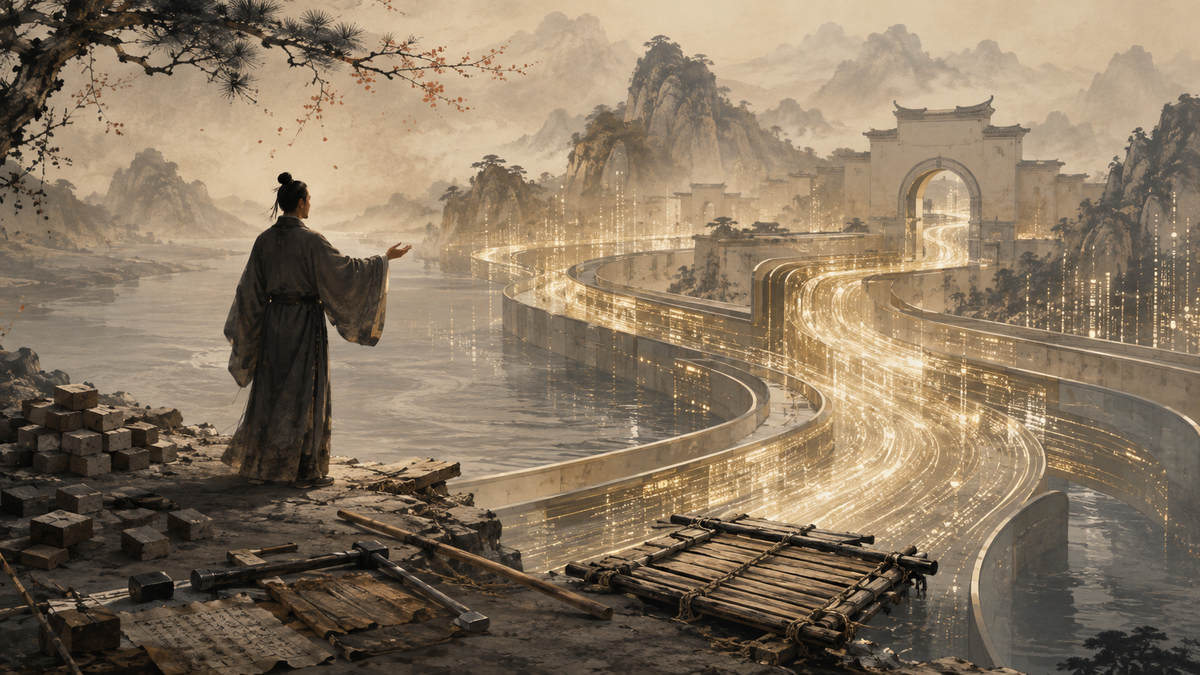
We have built an entire culture out of mistaking the tool for the craft, and the friction for the value.
If you ask a software engineer or a writer today what they do, they will almost certainly describe a list of mechanical tasks: I write TypeScript. I refactor legacy modules. I draft essays. I edit prose.
We measure our worth by the weight of our sweat. We take pride in the friction—the late-night debugging session, the agonized staring at a blank page, the bloody battle with syntax. We treat this struggle as a badge of moral honor. It feels noble. It feels earned.
It is also an illusion.
We are currently witnessing a collective identity crisis across engineering and creative fields because generative AI has made mechanical execution—the task—trivially easy. Because we tied our self-worth to the friction of execution, we feel devalued. We scream that the machine has no "soul," that it lacks "lived experience," that it is ruining the "craft."
We are romanticizing our suffering because we have forgotten a fundamental truth: The task is not the job.
The Western Reductionist Trap vs. Eastern Tool Pragmatism
Much of the current anxiety surrounding AI stems from a uniquely Western reductionist worldview—one shaped by Cartesian dualism and the Protestant work ethic.
Western thought has spent centuries breaking human activity down into atomic, mechanical parts. It treats the worker as a factory, and the act of creation as an accumulation of individual, manual inputs. Under this reductionist lens, moral value is directly proportional to human suffering: if you didn't sweat over the mechanics, you didn't truly create it. When an algorithm automates those mechanics, the Western reductionist experiences an existential void. They believe the "soul" of the work has been stolen because they reduced the soul to the labor itself.
By contrast, Chinese technological adoption operates on a profoundly different philosophical instinct. Chinese creators and engineers rarely waste time agonizing over whether using an AI tool makes them "less authentic." They adopt new tools with ferocious speed because Eastern philosophy has always viewed tools not as rivals to human identity, but as extensions of systemic momentum.
Confucius famously noted in The Analects (《論語》):
君子不器。
(Jūn zǐ bù qì.)
"The noble mind is not a mere instrument or tool."
A human being's value was never meant to be defined by being a specialized cog that executes mechanical steps. The tool (器) is replaceable; the intent, governance, and moral vision behind it are not.
Xunzi (《荀子·勸學》) captured this pragmatic leverage over two thousand years ago:
假輿馬者,非利足也,而致千里;假舟楫者,非能水也,而絕江河。君子生非異也,善假於物也。
(Jiǎ yú mǎ zhě, fēi lì zú yě, ér zhì qiān lǐ; jiǎ zhōu jí zhě, fēi néng shuǐ yě, ér jué jiāng hé. Jūn zǐ xìng fēi yì yě, shàn jiǎ yú wù yě.)
"He who leverages a carriage and horses does not have faster feet, yet he travels a thousand miles; he who leverages a boat does not naturally swim, yet he crosses rivers. The noble mind is not born superior; it is simply skilled at leveraging external tools (假物)."
Chinese creators don't revere the paddle; they care about getting across the river. To refuse a faster boat out of nostalgia for paddling is not moral purity—it is strategic foolishness.
The Task as Ego-Shield
Why, then, does the Western mind cling so desperately to manual execution? Why are we terrified to embrace the model of I think, I direct, I publish?
Because the task is comfortable. The task is a hiding place.
《道德經》第十三章 (Dào Dé Jīng, Chapter 13):
何謂寵辱若驚?寵為下,得之若驚,失之若驚,是謂寵辱若驚。何謂貴大患若身?吾所以有大患者,為吾有身,及吾無身,吾有何患?
(Hé wèi chǒng rǔ ruò jīng? Chǒng wéi xià, dé zhī ruò jīng, shī zhī ruò jīng, shì wèi chǒng rǔ ruò jīng. Hé wèi guì dà huàn ruò shēn? Wú suǒ yǐ yǒu dà huàn zhě, wéi wú yǒu shēn, jí wú wú shēn, wú yǒu hé huàn?)
When you are obsessively focused on the manual labor of execution, your ego gets to build a "self" (有身 / yǒu shēn) out of effort. You construct an identity around being a hard worker, a master craftsman, a diligent laborer. If a project fails, or if a piece of writing falls flat, you can always retreat behind the defense of your toil: "But look how hard I worked on this code. Look how many hours I spent writing this essay."
The effort becomes your armor.
When technology strips away the friction of execution, it strips away the armor. It forces you out into the open. Suddenly, you can no longer hide behind how much energy you expended. You are judged entirely on judgment, taste, vision, and outcome.
If you direct an AI to generate an architecture or an essay, and the result is derivative, brittle, or soulless—you cannot blame the tool. You approved it. The responsibility sits squarely on your shoulders.
The shift from laborer to director isn't a loss of value. It is a terrifying escalation of accountability.
The Parable of the Raft: 執著 (Attachment to the Tool)
Buddhism offers an even sharper diagnosis of why we cling so fiercely to manual labor: we suffer from 執著 (zhízhuó)—an obsessive attachment to the form of our work rather than its true function.
In the Alagaddūpama Sutta (Majjhima Nikāya 22), the Buddha offers the famous Parable of the Raft (筏喻 / fá yù). A traveler builds a heavy wooden raft out of grass, twigs, and branches to cross a dangerous, rushing river. Upon reaching the other shore, instead of leaving the raft behind, the traveler straps the heavy wooden structure onto his back and trudges down the road, proud of how much effort he spent building it.
This is precisely what engineers and creators are doing when they insist on manually typing every line of boilerplate syntax or drafting every generic paragraph by hand. We are carrying the raft on our backs through the woods.
《金剛經》 (The Diamond Sutra) captures this delusion in eight words:
法尚應捨,何況非法。
(Fǎ shàng yīng shě, hé kuàng fēi fǎ.)
"Even the Dharma (the tool, the raft) must be abandoned once it fulfills its purpose; how much more so that which is not essential?"
We have confused the physical form of labor (相 / xiàng) with the ultimate reality of value (實相 / shíxiàng). Typing syntax is not the craft; it was merely the raft we built to get across the river. Now that technology has bridged the shore, carrying the raft isn't dedication—it is ego.
上善若水 vs 上善治水: The Architecture of Flow
《道德經》第八章 (Dào Dé Jīng, Chapter 8) gives us the ultimate design pattern for true utility:
上善若水。水善利萬物而不爭,處衆人之所惡,故幾於道。
(Shàng shàn ruò shuǐ. Shuǐ shàn lì wàn wù ér bù zhēng, chǔ zhòng rén zhī suǒ wù, gù jī yú dào.)
Most are familiar with the received text—The highest good is like water (上善若水). But bamboo slip manuscripts like the Mawangdui texts suggest an older, structurally active variant: The highest good governs like water (上善治水 / Shàng shàn zhì shuǐ).
This distinction reveals everything about how we ought to relate to modern automated systems.
若水 (ruò shuǐ) is passive resonance—it reminds us that code and prose are not ends in themselves, but merely fluid vessels responding to human need. Software does not create human need; it responds to it. The best code has always been no code—a reluctant, necessary medium.
治水 (zhì shuǐ), however, is active governance and direction. It evokes the ancient lineage of Yu the Great (大禹治水), who did not fight the natural flow of the flood, nor try to hold back every drop of water with his bare hands. Instead, he worked with the current, carving channels to guide the water where it needed to go.
For decades, engineers and writers spent 90% of their energy trying to build dykes by hand—manually typing syntax, managing boilerplate, and polishing mechanical grammar. We fell in love with carrying the sandbags. We called that manual labor "the craft."
AI is simply the opening of the floodgates.
Trying to stop it by clinging to manual typing is foolish. True craft is 治水—governing the flow. It is stepping back from the brute labor of moving the water ourselves, and using our intent to channel the current toward real utility. The real job was never the manual labor of execution; it was 治水 (zhì shuǐ)—the discernment of real needs, the governance of system flow, and the quiet vision to shape where that energy goes.
The Core Essence: 命 vs 運
In classical Chinese thought, existence is understood through two distinct realms: 命 (Mìng) and 運 (Yùn).
- 命 (Mìng* / Macro Baseline):** The underlying architecture handed down by Nature, technology, and epoch. It is the compute, the foundation models, the hardware, and the irreversible shift toward automated execution. You do not choose it, and you cannot stop it with manual labor. It is the river in which you float.
- 運 (Yùn* / Agency & Trajectory):** The human lever. It is how you navigate through that architecture. It is your intent, your constraints, your discernment, and your taste.
The tragic mistake of the modern creator is wasting their agency (運) fighting the macro landscape (命). They exhaust their limited human energy manually doing what a machine can execute in seconds, mistakenly believing that self-inflicted friction equals merit.
True craft is 無為 (wú wéi)—action aligned with the flow of the 大道 (Dà Dào). You do not beat the ocean by trying to slap the waves with your bare hands; you learn how to steer the ship.
When I prompt an AI to write code or draft text, I do not ask it to think for me. I force it to execute through my framework. I give it my style, my architectural rules, my edge-case philosophies, and my specific voice.
I am deploying my human agency not to perform low-level mechanical execution, but to exercise governance over taste. I set the parameters. I audit the output. I reject the generic. I align the system with human need.
The best architecture has always been invisible. The best code is the code that doesn't need to announce itself. Why should the process of creating it be any different?
Shattering the Illusion
The romanticization of manual craft is nothing more than the ego trying to protect its old metrics of self-worth. It is the anxiety of realizing that the barrier to entry for execution has collapsed, leaving only the quality of our mind on display.
If you are a software engineer, your job was never the syntax. Your job was system design, risk allocation, edge-case reasoning, and problem-solving.
If you are a writer, your job was never the typing. Your job was point of view, truth, resonance, and perspective.
The tool does not diminish your value. It exposes whether you had any value to offer beyond raw labor in the first place.
《道德經》第九章 (Dào Dé Jīng, Chapter 9) reminds us:
功遂身退,天之道。
(Gōng suì shēn tuì, tiān zhī dào.)
Stop clinging to the labor just to prove you worked. Let the tool do the heavy lifting, leave the raft at the shore, and focus on whether the work was worth doing in the first place.