The Fixed Life: On Fate, Karma, and the Illusion of Control
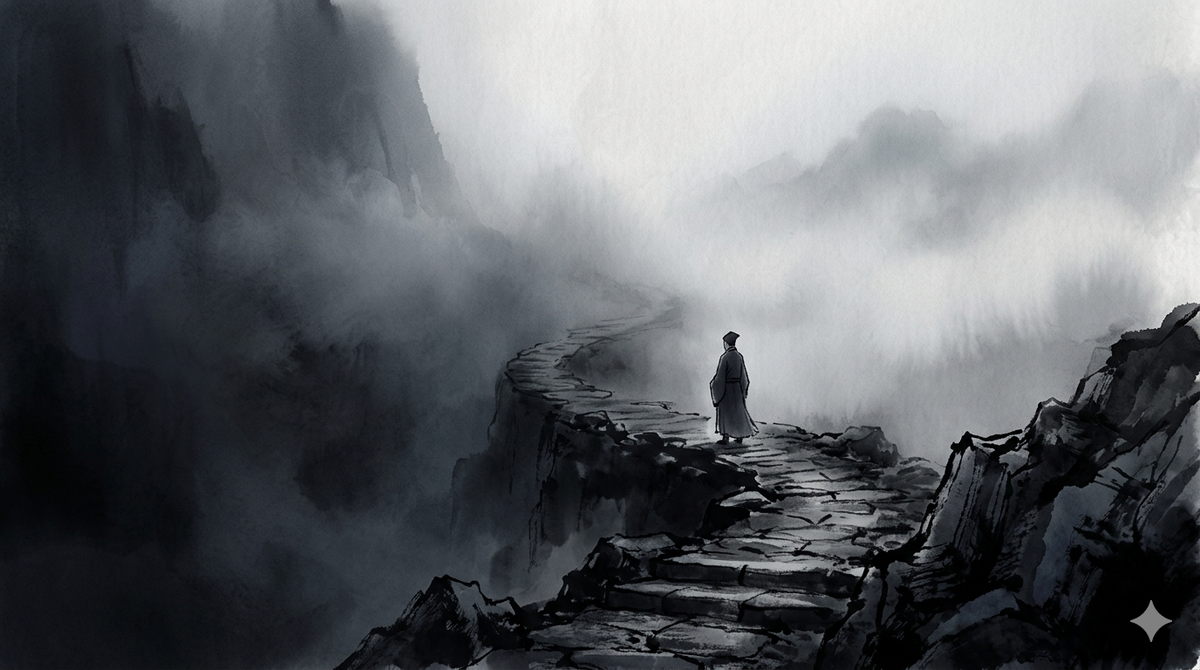
There is a question I have been sitting with for some time now — not as an abstract philosophical puzzle, but as a lived confrontation with my own life. The question is this: how much of what happens to us is truly chosen, and how much was already written before we arrived?
I used to resist this question. It felt defeatist. Determinism, in the Western framing I inherited from years in the engineering world, seemed like an excuse — a way of avoiding accountability, of letting oneself off the hook for poor decisions. But the more I have sat with the Taoist and Chinese metaphysical frameworks I practice within, the more I have come to understand that fate and accountability are not opposites. They are, in fact, the same thing seen from different angles.
The Container We Are Born With
In Chinese metaphysical thinking — across 紫微斗数, 八字, and the broader cosmological framework — a person is understood to arrive in this life with a specific energetic configuration. This isn’t merely a natal chart as Western astrology might frame it. It is closer to a blueprint of the soul’s karmic inheritance: the size of the wealth container one can fill, the nature of the relationships one will encounter, the quality of fortune available, and the kind of work one is here to do.
The wealth container is a concept I find particularly precise. The tradition holds that each person’s capacity to accumulate — whether material, relational, or spiritual — is bounded by the 福报 they carry from previous lives and the karmic weight of the ancestral line they were born into. This isn’t a ceiling imposed arbitrarily. It is a direct expression of what the soul has generated, spent, and left unresolved across lifetimes.
What this means practically is that no amount of financial engineering, investment optimisation, or strategic effort can permanently exceed the container’s limit. Wealth may fill to a certain level — and then something drains it back. The specific instrument of drainage changes: a market disruption here, an unexpected expense there, a poor financial product entered into under conditions that seemed reasonable at the time. But the net result is consistent. The container self-regulates.
I have watched this operate in my own life with a kind of detached clarity that took years to develop. Every time one vessel filled, another drained to compensate. The system was not malicious. It was simply accurate.
Karma Is Not Punishment
The moment most people encounter the idea of karmic constraints, something in them rebels. It sounds like punishment. It sounds like being told you deserve what you get — and by extension, that suffering is deserved.
This is a fundamental misreading of how karma actually functions within the Taoist and Buddhist frameworks.
Karma is not a judicial sentence handed down by a cosmic authority. It is closer to physics. Action generates consequence. Patterns established across lifetimes create energetic grooves that the soul continues to travel until the groove is either worn smooth through repetition or deliberately redirected through cultivation. The constraint is not punitive. It is structural.
More importantly — and this is what took me the longest to truly absorb — karmic constraints are often the most precise expression of what the soul actually needs. A person who accumulated power in past lives, who commanded and directed the fates of others, may arrive in a present life with a wealth container that simply will not hold. Not because they are being punished for past accumulation, but because the soul’s next stage of development requires learning to function without it. The constraint is the curriculum.
The Taoists understood this through the concept of 損 — subtraction, reduction, decrease. Chapter 48 of the Tao Te Ching: 為學日益,為道日損. In the pursuit of knowledge, every day something is added. In the pursuit of the Tao, every day something is taken away. A life structured around loss, limitation, and the repeated stripping of external supports is not a failed life. It may be a life running precisely according to its deepest design.
Ancestral Karma and the Lineage We Choose
There is a layer of fate that operates beyond individual karma: the karmic inheritance of the ancestral line. Chinese folk religion and Taoist cosmology both hold that the actions of ancestors — their debts, their 冤孽, and sometimes the curses placed upon them by those they harmed — flow downstream through bloodlines until they are resolved, discharged, or transformed.
This is not a comfortable idea. It means that a person may be living within constraints they did not personally generate — carrying the weight of what great-grandparents did in circumstances they know nothing about. The wealth that drains inexplicably. The relationships that fray without obvious cause. The sense of working harder than the results warrant.
But here is where the framework becomes genuinely profound rather than merely sobering: many traditions hold that souls do not randomly inherit ancestral karma. The soul selects the lineage that matches its own karmic configuration and cultivation assignment. The family line is not an accident. It is a fit.
This reframes the question of suffering entirely. The person born into a lineage carrying heavy ancestral debt is not a victim of bad cosmic luck. They may be precisely the soul whose configuration — whose capacity for endurance, whose cultivation practice, whose particular energetic quality — was suited to absorb and transform what that lineage had accumulated. Not to pay the debt in the sense of suffering as repayment. But to end the pattern. To be the one in whom the inherited groove finally smooths out and stops generating.
This is what the tradition sometimes calls a 修行 life prescription. Not a life organised around accumulation, achievement, or relational fulfilment as primary axes. A life organised around internal refinement — where the external constraints are not obstacles to the purpose but the very conditions that make it possible.
What Fate Actually Asks of Us
If life is this fixed — if the container size is set, the ancestral karma is inherited, and the 大限 periods unfold according to their own internal logic — then what exactly is the role of human effort and choice?
This is where I think the Eastern frameworks are most often misunderstood by the Western mind.
Fate does not eliminate agency. It clarifies it.
Once you understand the container you are actually working within — rather than the container you wish you had — your energy stops leaking into futile attempts to exceed it. You stop pouring resources into financial instruments your wealth palace cannot hold. You stop straining against the relational structures that your configuration is simply not built for. You stop interpreting the repeated drainage as personal failure requiring correction.
And in that stopping, something unexpected happens. The energy that was being spent fighting the structure becomes available for what the structure is actually designed to support. In a 修行 life, that energy goes inward. The cultivation deepens. The internal work proceeds with a quality of attention that simply wasn’t available when most resources were directed outward.
This is not resignation. Resignation is passive. What the tradition actually asks for is more demanding than effort: it asks for accurate action, aligned with the actual configuration of one’s life rather than an imagined one.
武曲, the metal star that governs direct action and financial affairs, offers an instructive image here. Metal does not become useful by fighting its nature. It becomes useful by being placed correctly — where its hardness, its cutting quality, its conductivity are precisely what the situation requires. The same nature that is destructive in the wrong context is indispensable in the right one.
The question fate asks is not: how do I accumulate more? It asks: what is my nature actually suited for, and am I deploying it there?
The Long View
There is a quality of peace that becomes available once this framework is genuinely inhabited rather than merely intellectually understood. It is not the peace of having solved the problem. It is the peace of having correctly identified what kind of problem it actually is.
A cashflow deficit is not a moral failure. A wealth container that self-regulates back to its ceiling is not evidence of incompetence. A 大限 period that strips away external supports is not cosmic punishment. These are the terrain features of a specific karmic configuration, running according to its own internal logic, serving a purpose that may not be fully visible from inside the difficulty.
The Taoist tradition speaks of 晚发格 — the late-blooming configuration. Certain stars, certain alignments, certain soul configurations are simply not designed to peak early. The expression comes in the second half of life, after the stripping, after the compression, after the internal work has been done that makes the later flowering genuine rather than merely fortunate.
Most people who are told they are a late bloomer find it difficult to hold. The pressure of comparison — with peers who seem further ahead, with cultural timelines that say success should arrive by a certain age — makes the waiting feel like failure. But within the framework I am describing, the late-blooming configuration is not a consolation prize for those who didn’t make it in time. It is a specific prescription: the kind of depth and stability that only develops under the conditions of extended difficulty is also the kind that doesn’t collapse when it finally arrives.
Living Within the Fixed Life
I want to be careful not to make this sound cleaner than it is. Understanding that your life is largely fixed by karma and fate does not make the difficulty painless. The financial pressure is still real. The loneliness of a solitary path is still real. The weight of ancestral karma running through a lineage is still real.
What changes is the relationship to the difficulty. When you stop interpreting your constraints as problems to be solved and begin recognising them as the precise conditions of your particular curriculum, something shifts. The energy that was going into resistance becomes available for traversal.
You stop asking why this is happening to you and begin asking what this is asking of you.
For a life prescribed around 修行, the answer is usually the same: go deeper. The external stripping is creating the conditions for internal development that would simply not occur if the external remained comfortable and stable. The container that won’t hold wealth is also the container that keeps directing attention back inward, where the actual work of this life is happening.
This is the fixed life. Not fixed in the sense of broken, but fixed in the sense of set — already written in its essential contours, unfolding according to a logic deeper than any single lifetime’s perspective can fully grasp. The task is not to rewrite it. The task is to inhabit it accurately, to bring the full quality of one’s attention and cultivation to the terrain that was always going to be this terrain.
In the Taoist framing I return to most often: you did not choose this life in the way you choose a product or a plan. But the configuration is accurate to who you are and what your soul is working through. The fit between the life and the soul is exact, even when — especially when — it is uncomfortable.
That exactness, once seen, carries its own strange comfort.
你来过。你做了你该做的。
You came. You are doing what needs doing.
The Reflective Engineer explores the intersection of Taoist philosophy, Chinese metaphysics, and the examined life. Views expressed are the author’s own engagement with these traditions as lived frameworks rather than academic positions.