Let Them Be: On Non-Interference, Taoism, and Working with Difficult People in a Small Team
There is a colleague I think about sometimes. She is in sales — sharp, driven, and genuinely good at her job. She is also, fairly often, frustrated. Not at us, exactly. At the customers. The ones who go back and forth on decisions already made. The ones who agree to a handover process and then quietly stop following it. The ones who do not do the follow-up they committed to, and then act surprised when things stall.
Her frustration is completely understandable. She is the one holding the relationship. When the customer drifts, she is the one who has to chase, explain, smooth things over, and somehow keep the deal alive. The mess lands on her desk, and nobody outside of sales really sees how much of it there is.
And yet. Watching her carry this — the tightness of it, the way it colours her whole day when a customer goes quiet or flips a decision she thought was settled — I find myself thinking about Taoism. Not because I want to wave philosophy at a real problem. But because what she is experiencing has a name in that tradition, and the name is useful.
Attachment to What Was Never Yours
The word is 執著, zhí zhuó — attachment. In Taoist thinking, attachment is not just about wanting things. It's about clinging to outcomes you cannot control. It's the grip you keep on how things should go, even as reality insists on going its own way.
In sales, this particular form of suffering is almost structural. You do everything right. You qualify the lead, you run the process, you get the verbal agreement, you send the follow-up. And then the customer goes dark for two weeks, comes back having reconsidered, and wants to restart a conversation you thought was closed. None of that is your fault. But you are the one who absorbs it.
The attachment, in this case, is to the customer behaving like a rational actor in a well-defined process. Which sounds reasonable. It is reasonable. It is also, frequently, not how people work.
People — customers included — are inconsistent. They say yes and mean maybe. They go quiet not out of disrespect but because their own world got complicated. They flip-flop not because they are difficult but because they are uncertain, and uncertainty does not follow a handover SOP.
This is not an excuse for poor customer behaviour. It is a description of how things are. And the Taoist question is always the same: how much of your peace of mind are you willing to stake on other people behaving differently from how they actually behave?
Wu Wei, and What It Is Not
The concept most relevant here is 無為, wú wéi — non-forcing. It is usually translated as non-action, which gives the wrong impression. It doesn't mean doing nothing. It means not pushing against what cannot be pushed.
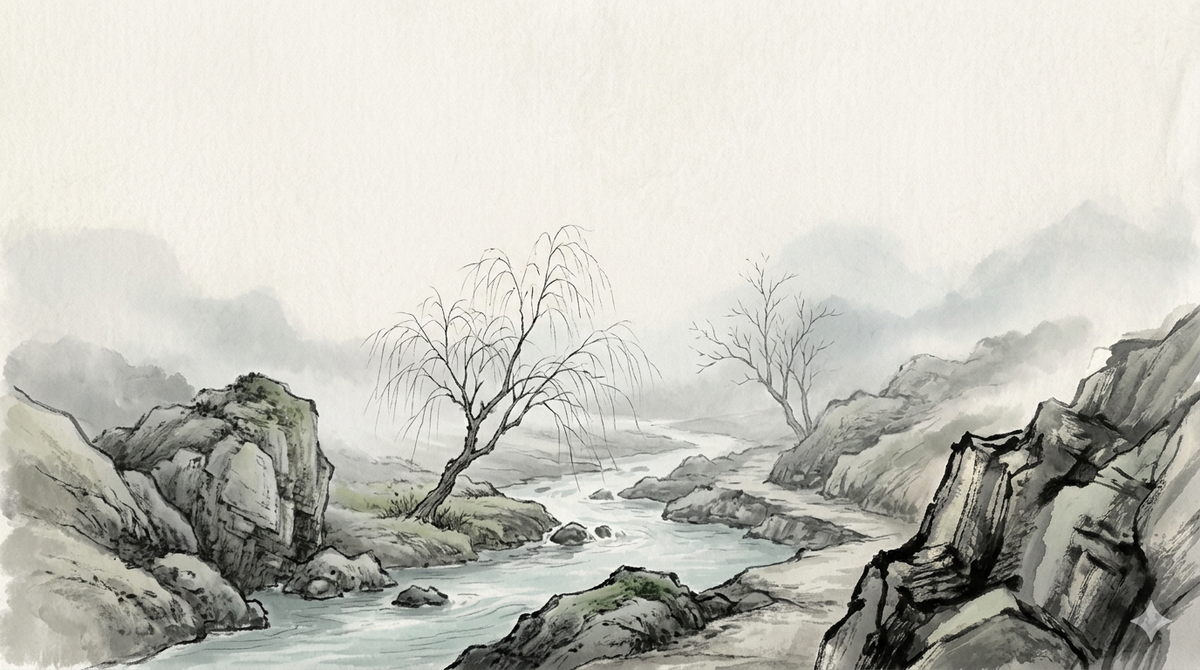
Water doesn't argue with the rock. It finds the way around, or it waits. Over time, it shapes the rock anyway — not through force, but through patient consistency. The water doesn't suffer because the rock is in the way. It simply flows.
Applied to a sales context: you can send the follow-up. You can set the expectation clearly. You can design the best handover process you are capable of designing. What you cannot do — what wu wei asks you to stop trying to do — is make the customer move on your timeline, or care about your process as much as you do, or behave with the consistency that would make your job easier.
Non-forcing is not passivity. It is the recognition that there is a boundary between what you can control and what you cannot, and that crossing that boundary in your mind — carrying the weight of outcomes that were never fully yours — is where the suffering comes from.
I have had to learn this in my own way, in engineering contexts. My version looked different — a need to over-justify decisions, to make sure people understood I had thought things through, to feel unsettled when something I had built was changed without explanation. I told myself it was conscientiousness. But underneath it was the same thing: attachment to outcomes I could not fully control, and a quiet refusal to accept that. Recognising it in myself makes it easier to recognise in others without judgment.
自然 — The Nature of Things
There is another concept worth sitting with: 自然, zì rán. Usually translated as 'nature', but more literally 'self-so'. The way things are of themselves, without being forced into shape.
Customers are self-so. They move at their own pace, with their own internal pressures you cannot see. A contact who goes quiet is probably not being obstructive — they are managing something else entirely, something that has nothing to do with your deal. Their world is as complicated and non-linear as yours. They are not a variable in a pipeline. They are a person.
This sounds obvious when said plainly. But in the daily reality of a sales role, where every open opportunity has weight and a deadline, it is easy to stop seeing customers as people and start seeing them as problems to be resolved. And once you do that, their human unpredictability becomes a personal affront.
My colleague is not wrong for feeling this. She is doing a hard job in a system that rewards control and punishes drift. The frustration makes sense. What Taoism offers is not a suggestion that she should stop caring. It is a different place to stand — one where the customer's inconsistency is expected rather than shocking, accommodated rather than fought.
You cannot change the nature of water by being angry at it.
What This Looks Like in Practice
I want to be careful here. Wu wei is not a reason to stop following up, stop designing good processes, or stop holding customers accountable.
There is a version of this philosophy that tips into learned helplessness, and that is not what I am describing.
What changes is not the action. It is the internal relationship to the outcome.
You send the follow-up — and then you genuinely release it. Not as a performance of calm, but because you understand that what happens next is not entirely up to you. You design the handover process — and then you accept that some customers will not follow it, not because your process is bad, but because people are people. You hold the standard — and then you stop paying for it emotionally when others do not meet it.
This is easier said than done. Possibly the hardest thing about working in a customer-facing role is that your metrics depend on other people's behaviour. There is no equivalent in engineering. If I write a function, the function does what the function does. It does not go quiet for two weeks and come back having reconsidered the requirements.
The suffering my colleague carries is real, and it is not hers to fix alone. Some of it belongs to the nature of the work. But some of it — the part that follows her home, the part that tightens her whole day when a customer goes sideways — that part is the grip. And the grip is something she has some say over, even if the customer's behaviour is not.
Why Non-Interference, Then
You might be wondering what any of this has to do with non-interference, which is where the essay started.
Here is the connection. When I watch my colleague struggle with this — when I am in a meeting and I can feel the frustration radiating off her because a customer has once again not done what they said they would — my instinct is to help. To suggest a different approach, to offer a framework, to point out that perhaps the expectation needs to be reset.
That impulse is not wrong. But it can become its own form of interference. She is not asking me to fix this. She is not asking me to explain to her why customers are unpredictable. She knows. She has been doing this longer than I have been watching her do it.
Wu wei, in this context, means letting her be in her frustration without trying to talk her out of it. It means trusting that she will find her own equilibrium, in her own time, in her own way. It means being present without immediately becoming a problem-solver when a problem-solver is not what is needed.
This is harder than it looks. Especially for people like me, who default to analytical responses. The offer of a framework is sometimes just the need to feel useful, dressed up as helpfulness.
A Thought on Compassion
What I have come to understand, spending time around people who carry their frustrations visibly, is that the frustration is almost never really about the thing it appears to be about.
My colleague is not primarily frustrated at customers. She is frustrated at the gap between how things should work and how they do. That gap is real. It costs her energy, reputation, and sleep. The attachment to closing that gap — to having the process followed, the handover completed, the decision honoured — comes from somewhere legitimate. It comes from caring about doing the job well.
Caring is not the problem. The grip is the problem. And the grip, in most people, comes from somewhere old — from environments where inconsistency had real consequences, from being let down enough times that you started bracing for it, from learning that if you did not hold things tightly they would fall apart.
I do not know her full story. I do not need to. It is enough to recognise that the tightness has a source, and the source is not weakness or irrationality. It is a person doing their best with the tools they have.
That recognition changes how I sit with her frustration. Not with solutions. Not with philosophy she did not ask for. Just with a steadiness that says: I see you, this is hard, and I am not going to make it harder by adding my own noise to it.
Let her be. Let the customer be. Let the river find its own way.
And in the meantime — do the work, stay steady, and keep your own grip
loose.
— Brandon Lim